The People Transformation
Section 10 of Agentic Banking Architecture: A Practitioner's Guide
Section 8 covered the structural side — the org chart, the reporting lines, who reports to whom. This section covers the day-to-day side. What actually changes inside the delivery cycle when agents handle the coordination.
Most of the people in a technology delivery organisation today exist to coordinate other people. Product managers translate business needs into requirements. Developers build across sprints. Scrum masters run ceremonies. QA tests separately. Programme managers track dependencies. Release managers gate deployments. The day-to-day work is not building — it is managing the complexity of many humans working on shared problems.
Agentic AI collapses that work. The activities that survive are the ones that require human judgement. Everything else compresses or disappears.
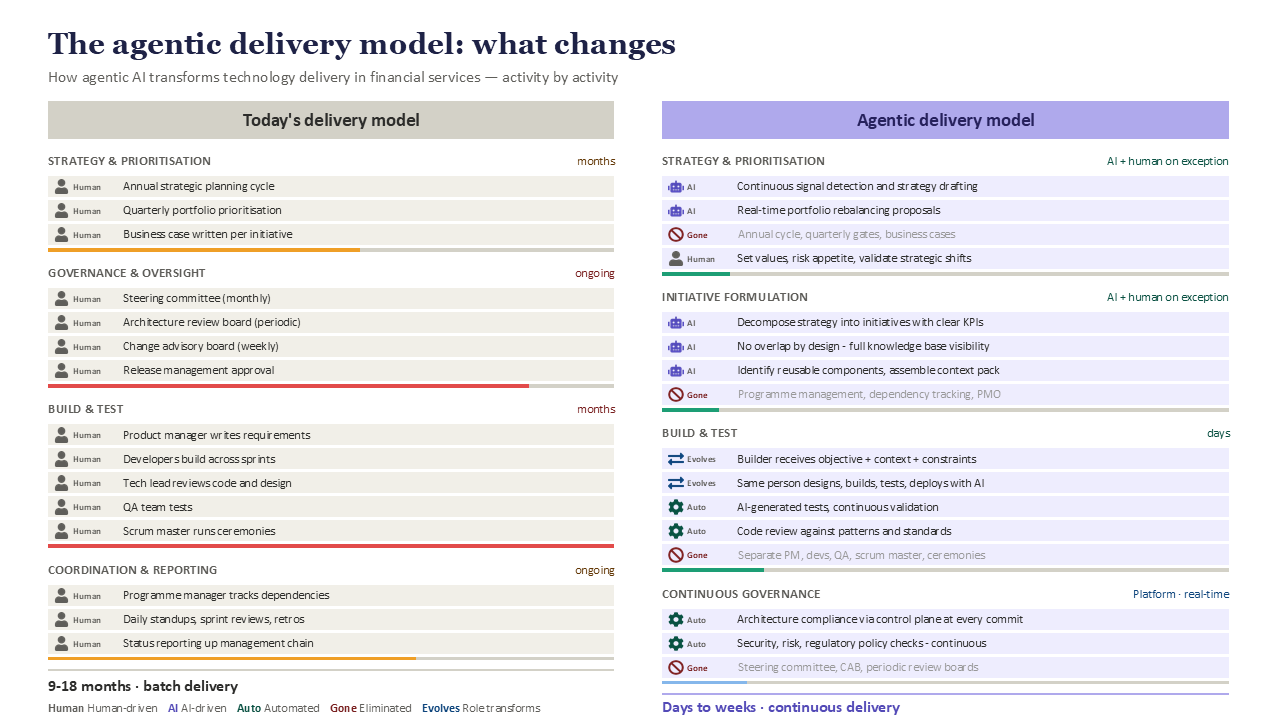
Activity by activity
The change is most visible when you look at the delivery cycle one activity at a time. Strategy, governance, build, release, knowledge — each shifts in a different way.
Strategy
Today: annual planning cycles, quarterly steering committees, slide decks summarising what's been heard from the business. Strategy formulation is a discrete event that produces a portfolio that's already out of date by the time it's approved.
Agentic: continuous signal ingestion. AI monitors customer feedback, regulatory changes, competitive moves, internal capability signals, and surfaces shifts as they emerge. Strategy becomes a continuous calibration rather than an annual artefact. The human role is judgement on direction, not synthesis of inputs.
Initiative formulation
Today: business case writing, stakeholder alignment, scope definition. A lot of effort goes into avoiding overlap with what other teams are already doing — which usually fails, because nobody has full visibility across the bank.
Agentic: AI formulates initiatives with full visibility of what already exists and what's in flight. Overlap is engineered out by design rather than discovered in steering committees six months later. The human role is to decide whether the initiative is worth doing — not to construct the proposal.
Build
Today: large teams running multi-quarter delivery cycles. Product manager writes requirements. Eight to twelve developers build across sprints. Scrum master runs ceremonies. Separate QA tests. The structure is built around the assumption that many humans need to coordinate to produce working software.
Agentic: one builder — a blended product-engineer working with AI — ships end-to-end in days, not months. The builder formulates the requirement, generates the code, drives the testing, and pushes to production. Most of the coordination roles disappear because there is much less to coordinate.
Governance and release
Today: periodic review boards, separate release management, manual compliance checks before deployment. Governance is a gate that adds latency and is enforced through meetings.
Agentic: continuous automated compliance through the control plane. Policies are enforced at runtime, not at release gates. Deployment is continuous. The human role is to calibrate the policies, not to approve individual releases.
Knowledge and onboarding
Today: tribal knowledge held in people's heads, transferred through long apprenticeships and lost when people leave. Onboarding a new joiner takes months because the institutional knowledge isn't written down.
Agentic: knowledge is codified as it is created — as policies, prompts, agent configurations, and decision logs. A new joiner has access to the same context the agents do. Onboarding compresses because the substantive knowledge is in the system, not in people's heads.
Roles: eliminated, evolved, emerging
The role changes follow from the activity changes.
Eliminated. The roles that exist to coordinate humans. Scrum master. Programme manager. PMO. Release manager. Separate QA. These survived in the previous era because human coordination was genuinely expensive. When AI handles coordination and the platform handles governance, they have no remaining function.
Evolved. Product manager and tech lead converge into the builder. The split between "what to build" and "how to build" was a coordination artefact — it existed because the two roles needed different skills and different time horizons. The builder, working with AI, does both. The role isn't smaller. It's broader and more accountable.
Emerging. The roles that keep the system honest. Strategy calibrator — the person who decides which signals to act on and which to ignore. Platform engineer — the person who builds and tunes the control plane that everything else runs on. Risk calibrator — the person who decides where the guardrails sit and when they need to move. These roles are small in number but high in leverage.
The substantive content of agentic deployment
One implication is worth drawing out explicitly. The codification of tacit knowledge is not preparation for agentic deployment. It is the substantive content of agentic deployment.
A lot of what makes banking actually run is in people's heads — judgement calls, exception patterns, informal escalation paths, the reasons rules exist. If that knowledge is not written down as transformation progresses, agents will make mistakes that humans would not have made. In the worst case, the knowledge is lost altogether as people get reassigned or leave.
The activity that looks like "writing documentation" is actually the activity that creates the system. The team that does it well builds an asset that compounds. The team that does it badly builds agents that are confidently wrong.
What this is not
This isn't a fully autonomous delivery organisation. It's a human-judgement organisation with automated execution. The humans set strategy, calibrate policies, make the judgement calls that determine direction. The agents execute, coordinate, and surface what needs human attention.
The headcount implications are significant, but putting a number on them would be dishonest. It depends heavily on legacy estate, transition pace, and how aggressively the bank pushes the agentic model. Anyone giving you a confident number is guessing.
What's more important than the number is the direction: the delivery organisation gets smaller, flatter, faster, and closer to the business. The people who remain are the ones who exercise judgement, not the ones who pass information between other people.
This section expands on ideas first published in a LinkedIn post on what changes in the delivery cycle under an agentic model. It is the activity-level companion to Section 8: The Delivery Organisation, which covers the structural side.