The Delivery Organisation
Section 8 of Agentic Banking Architecture: A Practitioner's Guide
Most of the people in a technology delivery organisation exist to coordinate other people. Product managers translate business needs into requirements. Developers build across sprints. Scrum masters run ceremonies. QA tests separately. Programme managers track dependencies across teams. Release managers gate deployments. The organisational structure isn't optimised for building — it's optimised for managing the complexity of many humans working on shared problems.
Agentic AI eliminates that need.
What changes
The agentic delivery model collapses the coordination layer. One builder — a blended product-engineer working with AI — ships end-to-end in days, not months. Strategy becomes continuous signal ingestion rather than an annual planning cycle. Initiatives are formulated by AI with full visibility of what already exists and what's in flight, so there's no overlap by design. Governance moves from periodic review boards to continuous automated compliance through the control plane.
The roles that disappear are the ones that exist to coordinate humans: scrum master, programme manager, PMO, release manager, separate QA. The roles that evolve are product manager and tech lead, which converge into the builder. The roles that emerge are the ones that keep the system honest: strategy calibrator, platform engineer, risk calibrator.
How the org restructures
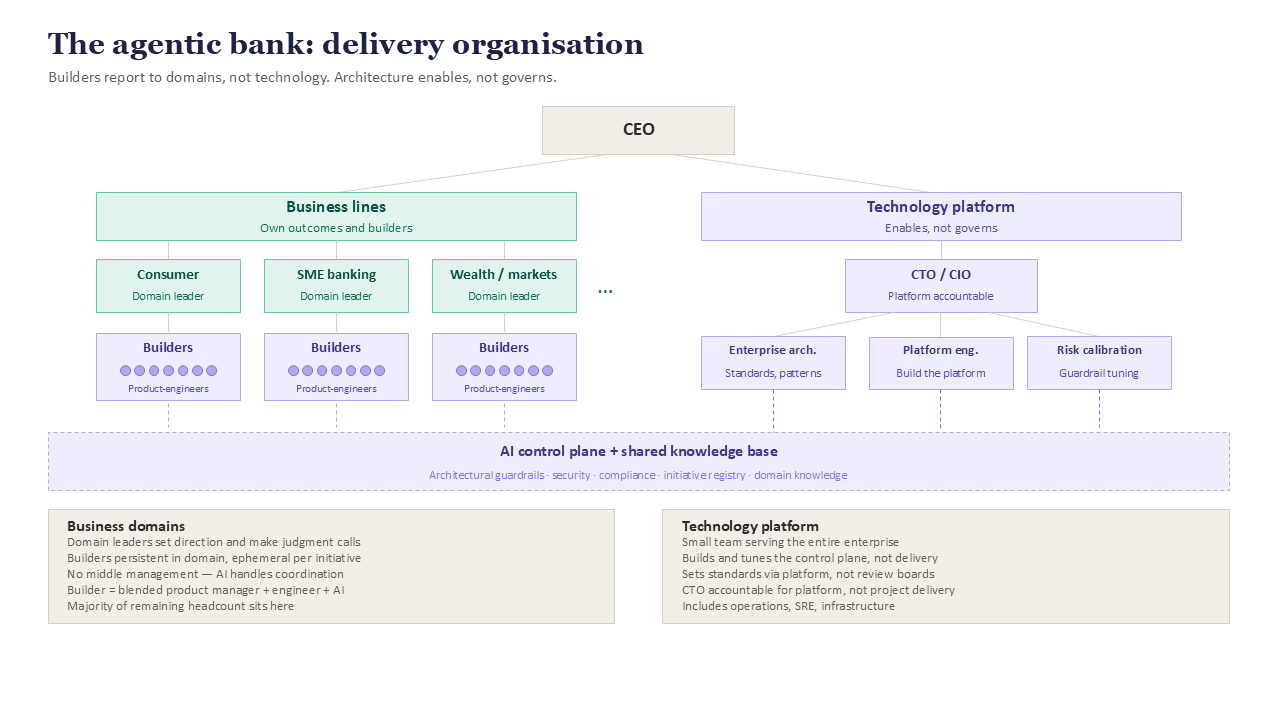
Builders report to business domains, not to technology. Domain leaders own outcomes and make judgment calls. The CTO doesn't manage delivery — they're accountable for the platform that enables it. Enterprise architecture, platform engineering, and risk calibration are a small shared function that serves the entire bank through the control plane, not through review boards.
No delivery managers. No PMO. The structure is flat because it can be — when AI handles coordination and the platform handles governance, the only human roles left are judgment and accountability.
The headcount question
The headcount implications are significant. But putting a number on it would be dishonest — it depends heavily on legacy estate and transition pace. Anyone who gives you a confident number is guessing.
What's more important than the number is the direction: the delivery organisation gets smaller, flatter, and closer to the business. The people who remain are the ones who exercise judgment, not the ones who pass information between other people.
This section is based on Part 8 in the LinkedIn series on agentic banking architecture. The org chart diagram was published with the original post. A detailed activity-by-activity comparison of traditional versus agentic delivery models will follow in a future update.